
The wonderful Portuguese culture
"Passion, culture, food and history"
Fado
"Feel the Portuguese guitar as the soul of the Saudade"
"Sinta a guitarra portuguesa como a alma da Saudade"
Feel the Portuguese guitar as the soul of the Saudade
Fado is known as Portugal's typical music, while it also is part of the Portuguese identity. You can't say Portugal without Fado and visa-versa. Feel the Portuguese guitar as the soul of the Saudade and learn why Fado is a real symbol of Portugal.
What are the topics of this post?
keywords:
#fado, #music, #guitar, #soul, #saudade, #fadista
What is Fado?
Fado is the musical expression of the Saudade, which is a combination of hope, melancholy, nostalgia, love an lucky feelings. Saudade stands for emotions, memories, hope and desire. You can learn more about Saudade in this post Saudade: What does it mean?
The typical instruments of the Fado
"2 Guitars to make the real sound"

Fado is Portugal's typical music genre and part of Portuguese identity. There are typical 2 instruments to make great Fado-music: the Portuguese guitar and a bass guitar. The Portuguese guitar is the main and most important instrument. This guitar has 12 strings instead of 6 strings for a standard guitar. The form of a Portuguese guitar is also a little bit different, more like the form of a pear. These 2 combinations are important for the typical sound of the Portuguese guitar. Mostly the player of the Portuguese guitar is accompanied by a acoustic bass guitarist, who form together the basics of the Fado music. Listen to the sound of the guitars to feel the Portuguese guitar as the soul of the Saudade.
"A fadista"
The singer blends the music together with wonderful words to touch the soul. Words of melancholy, hope, happiness, desire, strong emotions, love, sadness and memories. A combination of joy and sorrow come together with a strong, powerful and penetrating voice. We call a singer of Fado-music a Fadista. Mostly the person is dressed in black clothes, which only emphasises the dark side of the story. Both are important for a great Fado song, while a top guitarist of the Portuguese guitar plays the key role to bring the Fadista to a higher level.
What is the origin of the Fado as a soul of the Saudade?
"Women sang out of hope and a dreamy wistfulness"
Fado is a music genre originated in the 19th century. It was born in the historical heart of Lisboa, the capital of Portugal. Women started to sing a song for there men, who were mostly sailers and long time away from home. They brought the feelings of nostalgia, hope, love, sadness, luck and absence in their songs. A dreamy wistfulness of someone who never will come back, while they still love this person very much. A way to resign to their fate, yet still harbouring hope. Hope that things will change and good things will return. These are exactly the same sentiments of Saudade.
The origin of traditional Fado and the Portuguese guitar as the soul of the Saudade
"Mouraria: Berço do Fado"

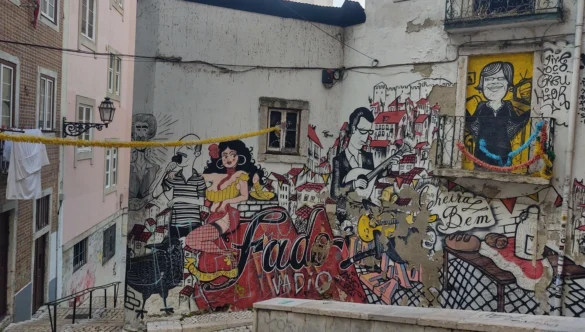
As already told above, the origin of the traditional Fado lies in the historical heart of Lisboa and dates back to the 19th century. The exact origin is situated in the neighbourhoods at the mountains of the castle. Mouraria is known as the cradle of the Fado, or in Portuguese "o berço do Fado". While at this moment, you'll find the most Fado-houses in the equally picturesque neighbourhood Alfama.
"Maria Severa as the first fadista"
Maria Severa lived in a small house in the narrow streets of Mouraria. She is known as the first fadista who sang the typical Fado songs. The house where she lived, is at the moment a traditional Fado-house. Here you can enjoy dinner in a setting where you can feel the Portuguese guitar as the soul of the Saudade. There is maybe no better place than the house where the first Fadista Maria Severa lived, to experience what fado is.
Other variants of Fado
"New influences in Bairro Alto"
In the 60s of the 20th century, they introduced newer variant of Fado in Bairro Alto to attract a new and broader audience. Fernando Maurício, who was a child from Mouraria, was an important fadista for this new influences. He also helped to bring Fado to the television. So, he is called the King of the Fado. You still find many Fado houses in Bairro Alto at this moment, while you still have to be in Alfama and Mouraria for the most authentic and traditional Fado.
"Coimbra with a Fado of love"
Coimbra also has its own typical Fado. The Fado of Coimbra has its origin from the students of the University. Students of the University brought Fado songs to find a woman. And they still do at this moment. This gives the Fado of Coimbra a more lovely vibe with more happiness and joy compared to the traditional melancholic Fado of Lisboa. The Fado of Coimbra is also usually sung by men, whereas the traditional Fado of Lisboa is sung mostly sung bu women. Butt the experience stays the same. They also use a typical Portuguese guitar and a bass guitar. So, by listening to the Fado of Coimbra you also are able to feel the Portuguese guitar as the soul of the Saudade.
Who are the most famous Fadistas?
Since the 19th century, there are many important Fadistas who made the Fado famous. While this genre became very popular within Portugal and part of the Portuguese entity, the Fado became also better known outside Portugal. Some famous names in the history of the Fado were Maria Severa, Amália Rodrigues, Fernando Maurício and Carlos do Carmo. Today, there still are the famous Fadistas Ana Moura, Cuca Roseta, Raquel Tavares, Camané, Gisela João and Mariza. As already told, Maria Severa is known as the first fadista and Fernando Maurício is the King of the Fado. Amália Rodrigues is known as "a Fadista". She is the biggest name in the history of the Fado. Amália brought the Fado to the people and was the greatest Diva of the Fado. At this moment, Mariza is the international most famous Fadista and gives concerts all over the world.
Where do you experience the Fado to feel the Portuguese guitar?
"A music genre of the cosy picturesque typical Portuguese living room"
Fado is a genre known as living room music. The best place to enjoy Fado and feel the Portuguese guitar as the soul of the Saudade is in a small and cosy space. So the best place to listen to Fado is in a picturesque room that is set up like a living room or a small typical Portuguese restaurant. While the great Fadistas give impressive and wonderful concerts in large halls, Fado is not really a music genre for large concert halls. In Alfama there is also a Fado Museum to learn everything from the Fado. But to really understand what Fado is, in Lisbon have to experience the best Fado in the typical Fado houses in the small streets of Alfama and Mouraria. Because these are the places of the home of the Fado.
Read More
"Selected for you"
You want to read more and get noticed about the posts ideal for you. Subscribe to our newsletter. This is the ideal way to stay tuned about all our posts and videos in the spotlight and selected for you.

The content of this page is copyright of Lindo Portugal.
© 2025 lindoportugal.eu
With media content of Galeria Sámuel.


Lindo Portugal
Passion, culture, food & history
© 2023-2026 lindoportugal.eu - All rights reserved.
Lindo Portugal is part of Voyageiro.eu.